In this case, the Predator Helios 300 doesn’t compromises on specs.
There’s still 16GB of RAM, just like most other GTX 1060 gaming laptops.
For the price, it seems like a great deal.
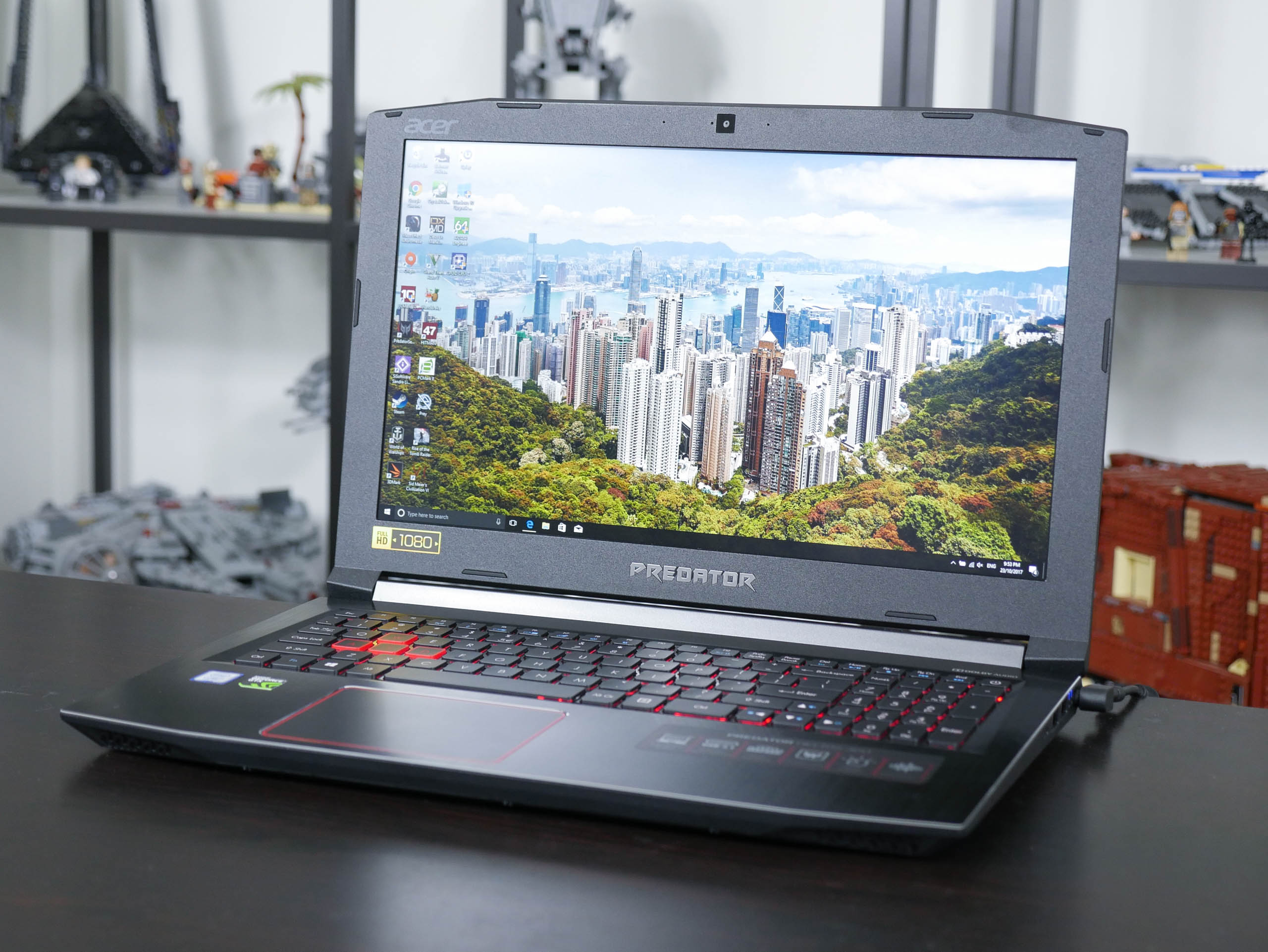
But there are some aspects to this laptop that Acer hasn’t prioritized.
The design is one of them.
It works, but only because this is an entry-level product.
Some like this aesthetic; I’m not a huge fan.
These are the only vents around the sides, so all exhaust goes through this one smallish port.
The selection of I/O ports on this laptop is, unsurprisingly, basic.
The right gets the power port, a 3.5mm audio jack, and two USB 2.0-A ports.
Ideally all three USB ports would support at least 3.0 speeds.
They keyboard is fairly typical for a laptop: nothing special but nothing bad either.
Its travel and tactile feedback is similar to many ultraportable laptops, with a spongy though not unbearable response.
The WASD keys are highlighted, and the keyboard has a red backlight.
Again, nothing special like RGB here, just your standard gaming laptop keyboard.
On paper, there’s nothing inherently wrong with the panel.
It’s a 15.6-inch 1920 x 1080 IPS LCD that runs at 60 Hz.
When you dig in to the performance of the display, however, serious issues are uncovered.
To start with, the panel on my review unit is only capable of 65% sRGB coverage.
This is completely unacceptable for any modern display, and quite frankly I was shocked at this result.
In fact I’ve seen plenty of other low-tier gaming laptops that offer much better sRGB coverage.
Images look flat and lacking punch as a result.
With this sort of gamut, it’s no surprise to see bad color accuracy.
The contrast ratio is okay, at 1160:1, and color temperatures are acceptable for the most part.
Brightness is also weak, at maximum of only 230 nits.
Will you notice the poor display during gaming?
