For this review, we’re sticking with the new format.
This way, you’re able to see the FPS data for every game tested.
As always, all CPU gaming benchmarks are conducted at 1080p using theGeForce RTX 4090.
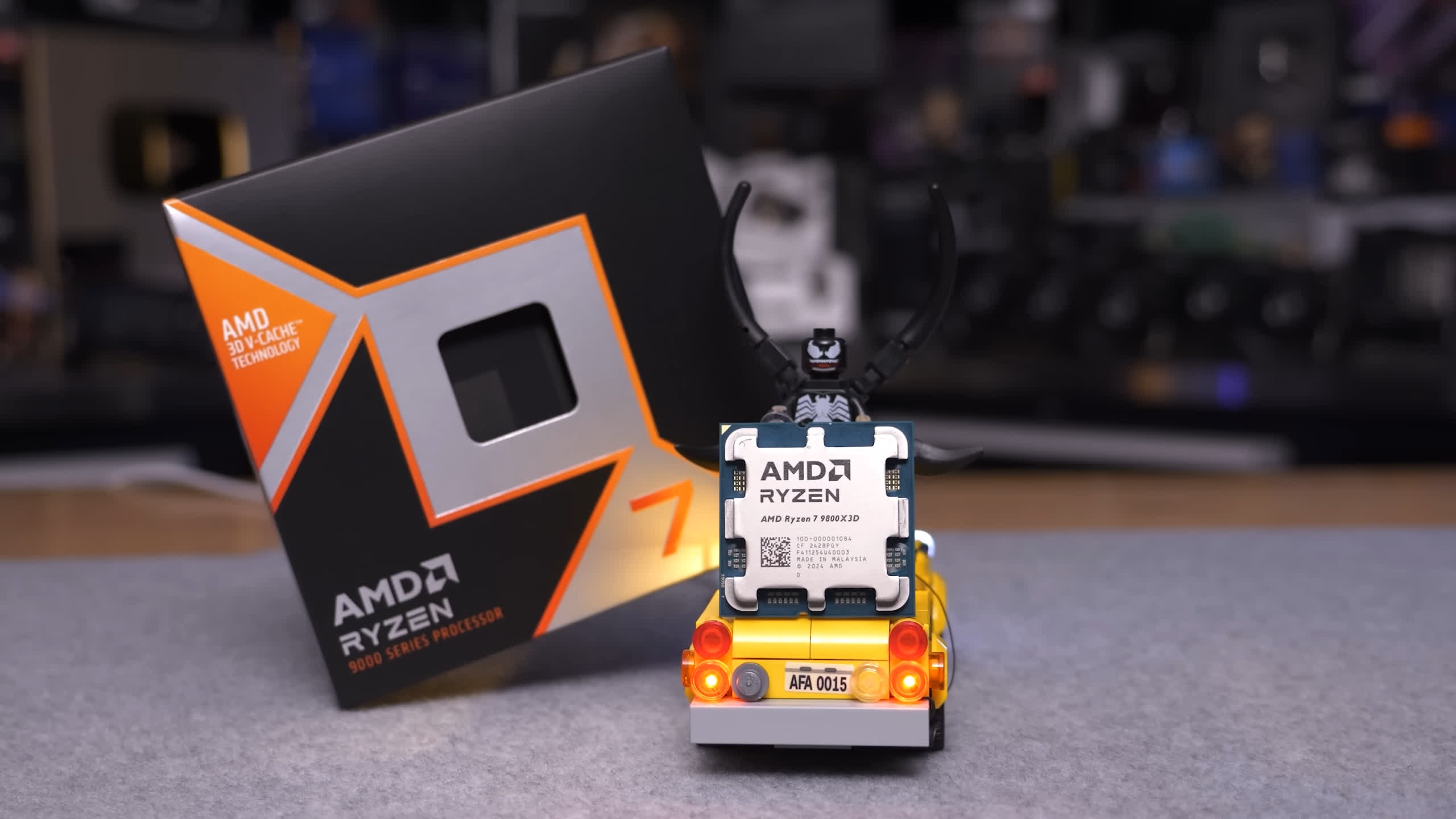
Now, let’s dive into the graphs!
In this scenario, both CPUs deliver exceptional performance, as expected from flagship processors.
However, the 285K stinks inCyberpunk 2077, choking the RTX 4090 to just 151 fps.
As a result, the Ryzen 7 processor is an impressive 45% faster.
The 9800X3D also crushes the 285K inHogwarts Legacy, delivering 43% better performance.
While performance improves for Intel inSpider-Man Remastered, the 9800X3D still maintains a 15% lead.
However, in Horizon Zero Dawn, the Ryzen 7 processor is 29% faster.
Next is Hitman 3, where AMD’s 3D V-Cache processor is just 7% faster.
Both CPUs provide more than enough performance for this older game.
Then we see that performance in Halo Infinite and Warhammer III is near enough to be identical.
This next set of results begins with Black Ops 6, where the 9800X3D is 19% faster.
Similarly, inBorderlands 3, the 9800X3D delivers a 21% improvement.
Finally, in Star Wars Jedi: Survivor, the 9800X3D delivers a crushing 45% performance lead.
And here we have yet more gaming data.
This also means the 9800X3D was nearly 50% faster.
However, the 9800X3D delivers a 19% performance uplift in Dying Light 2.
This results in the 9800X3D being 62% faster.
Hopefully, this will be resolved soon.
Similarly,Star Wars Outlawsis CPU-intensive, but here, the 9800X3D is just 5% faster.
Lastly, in Dragon Age: The Veilguard, the 9800X3D maintains a 15% lead.
There are no instances where the Ryzen processor was slower.
Margins within 5% are considered a tie, as differences of 1 3% are not statistically significant.
Across the 45 games, we found the 9800X3D to be, on average, 24% faster.
While this margin is smaller than our review data, that’s because reviews often emphasize CPU-limited gaming.
This dataset includes several GPU-limited titles, such as Forza Horizon 5.
When looking at the 1% lows, the story remains largely the same.
The 9800X3D provides, on average, 29% better 1% lows.
Granted, the Core Ultra 285K is a much better productivity CPU.
However, that’s not the competition the9800X3Dwas built for it’s designed for gaming.
Worse still for the 285K, the Ryzen 9 9950X3D is expected early next year.
It will likely claim the productivity crown from Intel’s 285K.
The 9800X3D is simply too fast.
It’s likely that Windows scheduling improvements will stabilize performance across a broader range of games.
Compatibility problems, such as those with Easy Anti-Cheat, also need to be resolved.
