You’d be correct; they did.
The Asus PG32UCDP is a WOLED alternative with similar specifications.
What will be more complicated will be choosing between these two as Asus has priced both at$1,300.
Features and Design
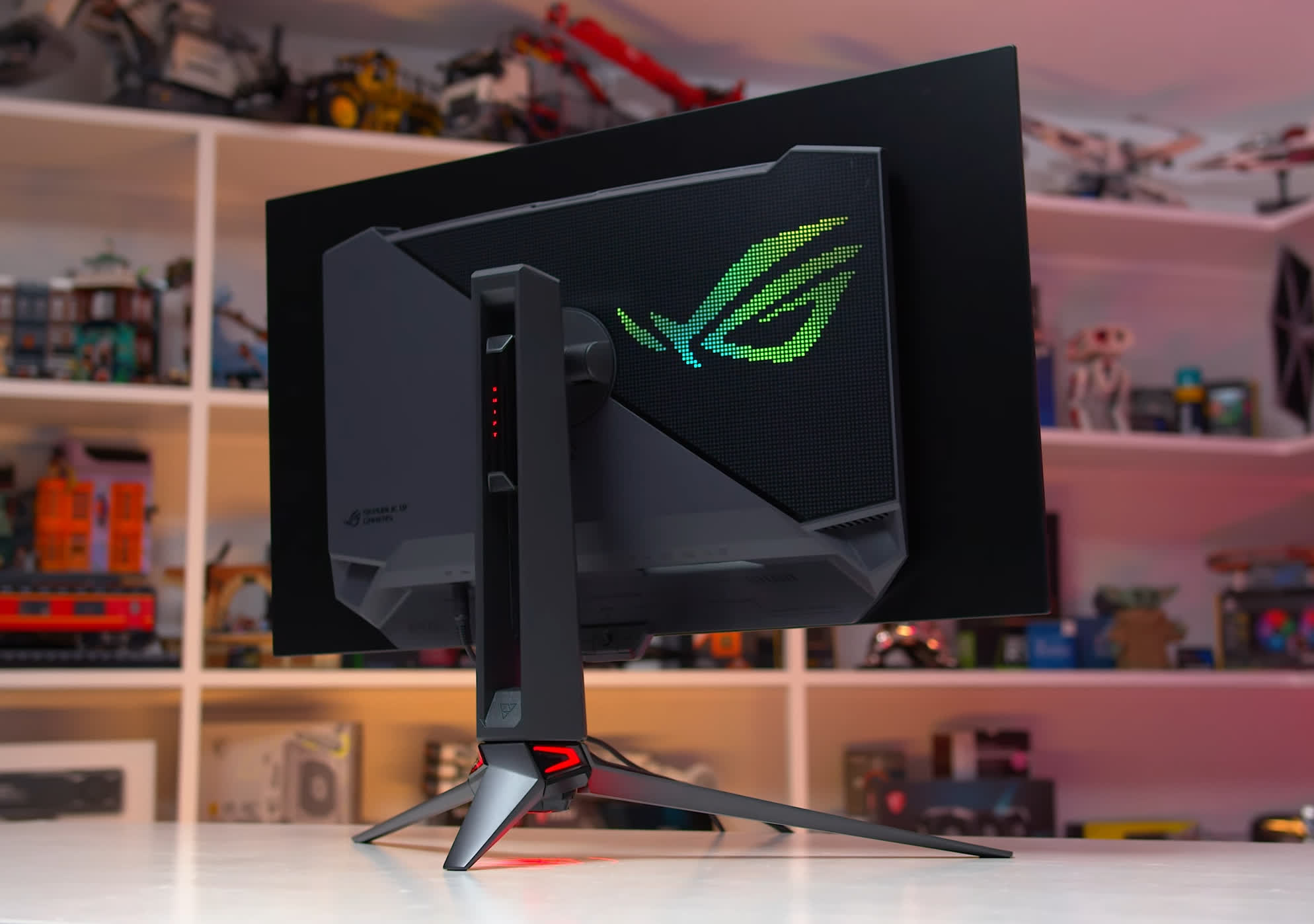
The PG32UCDP WOLED closely resembles thePG32UCDM, with Asus reusing their 32-inch OLED design.
The OSD controls are located behind this logo.
There’s even a projected ROG logo at the bottom of the stand pillar.
There’s a three-port USB 3.2 hub and a built-in KVM switch, which the LG model lacks.
DSC can be disabled in the OSD for compatibility reasons, at the cost of refresh rate.
To us, this sounds like cheating.
This results in a significant improvement in text quality compared to previous WOLED panels.
We have a full feature exploring thedifferences between 4K WOLED and QD-OLEDpanels.
The main advantage of the matte coating and WOLED screen composition is their performance in brighter environments.
WOLED preserves deeper blacks in bright rooms by reflecting less ambient light.
In some environments, the matte coating’s light diffusion can also result in a lower apparent contrast ratio.
In a light-optimized setup, glossy QD-OLED typically looks clearer with more ‘pop’ to the image.
However, for those who mainly use their monitor for entertainment, this should not be an issue.
Asus offers a better burn-in warranty than LG with their WOLED variant.
The Asus website clearly specifies a three-year warranty that includes panel burn-in.
In contrast, LG offers only a two-year warranty, with no specific mention of burn-in coverage.
The major limiting factor to OLED motion performance right now is the refresh rate itself.
This means motion clarity is identical when the refresh rate is the same.
So the same response times, input processing lag, HDR support, and color performance.
Obviously, the 1080p 480Hz configuration is designed exclusively for fast-paced gaming.
What’s of most interest with this mode is motion clarity.
One is ELMB black frame insertion, which the LG model doesn’t support.
It achieves this by technically running at 240Hz for a 120Hz signal input.
You also have to sacrifice VRR, HDR, and some brightness.
The second feature is OLED Anti-Flicker, designed to combat variable refresh rate flicker in rare scenarios.
Like we saw in the Asus XG27AQDMG, all this feature does is nerf the VRR range.
The good news here is that this is a less aggressive nerf than we saw with the initialXG27AQDMGimplementation.
For that reason, we can’t recommend using the high mode.
Anti-Flicker on middle, though, seems to work well and is a setting to consider using.
In one of these examples inCyberpunk 2077, enabling Anti-Flicker on middle reduced but didn’t fully eliminate flickering.
Impressively, there is no difference in processing delay using the 4K 240Hz or 1080p 480Hz modes.
You’ll also see similar input latency in the HDR mode; no changes there.
Power consumption, as with most OLEDs, is on the high side when displaying 200 nits full white.
The UCDP has great factory calibration for the most part.
In ColorChecker, it’s much of a muchness.
Where Asus has done well yet again is including a fully unlocked sRGB mode.
This is a negligible difference and on the whole, still behind most typical LCD panels.
Minimum brightness is great at 31 nits.
Viewing angles from this WOLED panel are great, no concerns there whatsoever.
Typically, what you are getting is better than what you’ll see from an LCD.
HDR Configurations and Accuracy
The Asus PG32UCDP is well suited to HDR from a hardware perspective.
For gamers especially, input latency on most OLEDs is low in the HDR mode.
The weakness in the HDR presentation on an OLED is overall brightness.
LCDs may not have per-pixel control, but zoned backlights can simply get significantly brighter in bright scenes.
There are multiple main HDR configurations, each with its own set of compromises.
This means that while shadow detail and mid tones are generally accurate, highlights are too bright.
Color accuracy in this mode is average to good.
Performance is similar to this in the Gaming HDR and Cinema HDR modes with slight adjustments to roll-off.
The last configuration worth discussing is the DisplayHDR 400 True Black mode.
These options leave us with mixed feelings.
We believe the UCDP could be better calibrated, with less over-brightening and a more balanced approach.
On the other hand, the UDCP does deliver decent performance in some areas.
The balance being struck here between all aspects of HDR is better if still compromised.
HDR Brightness
In synthetic brightness tests, full screen brightness is very similar between all OLED models.
However, the True Black mode lags behind at just 470 nits.
The real scene brightness results are certainly interesting.
The True Black mode is obviously quite dim, though accurate.
Most scenes are unaffected, with some of the brightest elements getting a small boost.
That said, this WOLED panel is substantially brighter for mid and higher APL content.
In scene 4 and scene 5, the UCDP is 77% and 51% brighter, respectively.
In gaming scene 2, we also recorded up to 28% higher brightness.
Meanwhile, for low-APL content, the UCDM can be 25% brighter.
This is why average brightness, calculated via the geomean, is so similar between the two panel types.
Speaking of accuracy, here’s greyscale deltaE performance.
However, ColorMatch performance is pretty good from the UCDP.
Lastly, we have HDR Color Volume.
In general, this gives QD-OLED a 35% advantage in ICtCp color volume.
DCI-P3 gamut coverage is borderline exaggerated, and there are the usual issues around response time numbers being misleading.
Input lag is low, there’s an sRGB mode with unlocked parameters, and KVM switch support.
No matter the jot down of gaming, we think you’ll find something to like about this monitor.
This is a decently bright monitor as far as OLEDs go, which helps deliver strong HDR performance.
We think it is, and that’s down to a few key benefits.
As it uses the same panel, most other characteristics are close to identical between the models.
At a 20 to 30 percent discount, the LG model would look pretty good.
So either way you go, you’ll be getting a top-end experience.
In which case, price becomes a pretty major factor.
At$1,300, the Asus ROG PG32UCDP is priced identically to thePG32UCDM.
