BenQ has optimized this product primarily for speed.
We’re examining a 24.5-inch 1080p 360Hz gaming monitor utilizing TN LCD technology.
Yes, we’re talking aboutTN tech, not IPS or VA.
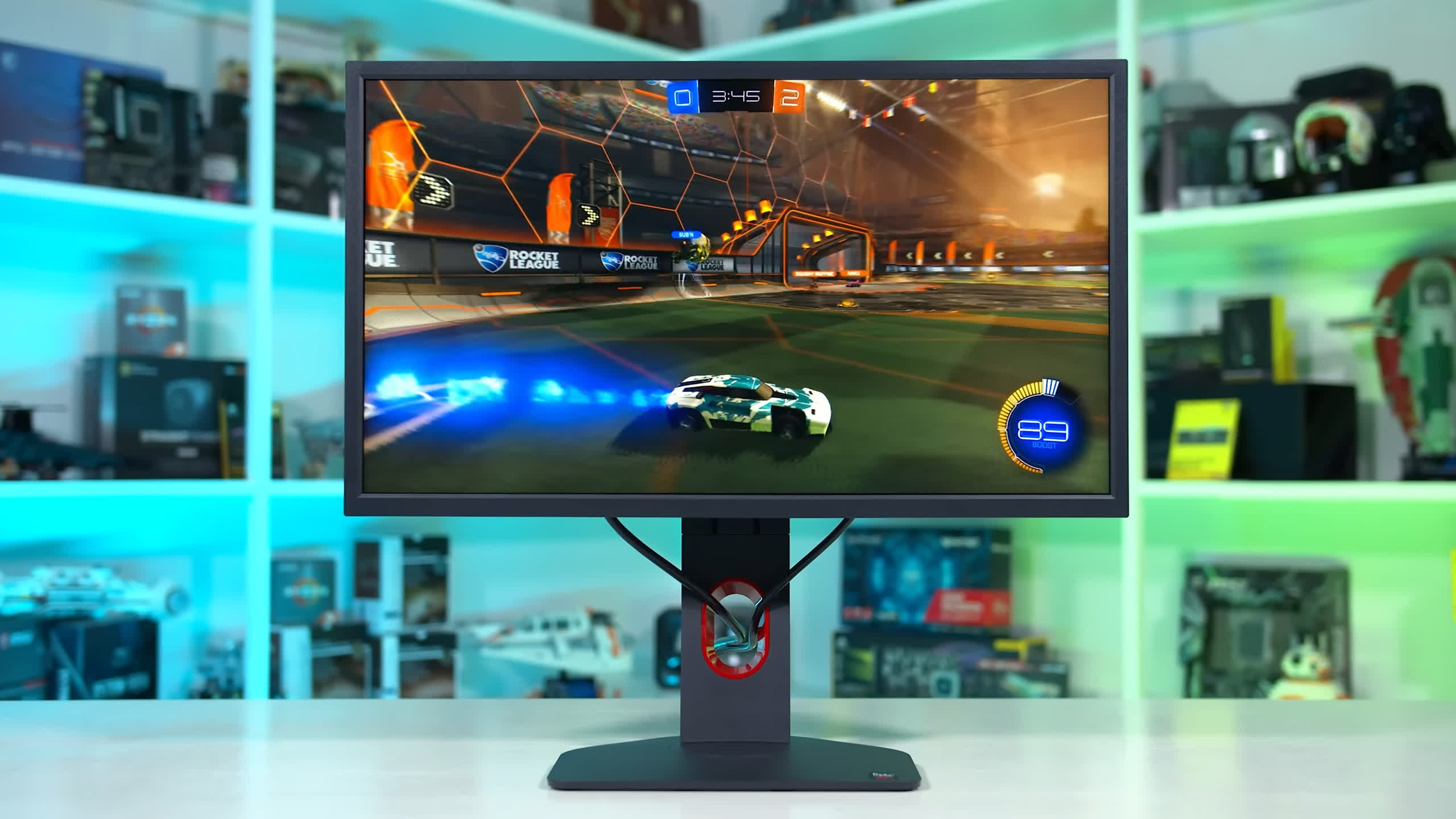
The amalgamation of 360Hz and TN is expected to deliver unparalleled motion clarity.
However, it’s specifically engineered for competitive play.
Connectivity is satisfactory, offering one DisplayPort and two HDMI ports.
Regrettably, the HDMI ports only support 2.0 spec instead of 2.1, limiting them to 240Hz.
The on-screen display is controllable through a directional toggle, and it was intriguing to examine the included features.
DyAc+ is naturally key, but there aren’t many other gaming features.
However, this does highlight the disparities between casual competitive multiplayer monitors and devices specifically designed for esports pros.
Display Performance
Let’s delve into the crucial aspect: motion performance.
The question arises: should you opt for the High mode or the Premium mode, barring user customization?
The High mode is superior across the refresh rate spectrum.
However, refresh compliance is slightly low for a 360Hz monitor with a refresh window of just 2.78ms.
As we mentioned, this mode is best optimized for the highest refresh rates.
For all other users, the High mode is ideal.
The comparison of the XL2566K with other monitors is quite intriguing.
The PG27AQN has a faster grey to grey average but achieves this at a higher level of overshoot.
The same holds true for the Samsung Neo G8, a 240Hz VA panel.
However, this BenQ monitor doesn’t quite compete with OLEDs.
While it’s approximately 1ms slower on average, it achieves this speed with a lower inverse ghosting rate.
This implies that the BenQ monitor operates at this speed with fewer artifacts than its counterparts.
Considering the cumulative deviation, the XL2566K on average is the best LCD monitor that’s been tested.
It also outperforms theHP Omen X 27, another fast TN monitor, by 18%.
However, OLEDs continue to lead the race, typically offering over five times the performance.
The XL2566K is undoubtedly designed for 360Hz gaming, but it also excels at lower refresh rates like 120Hz.
Here, its speed, combined with minimal artifacts, remains unmatched by other LCDs.
At 60Hz, the BenQ monitor performs well, albeit not as strong as at other refresh rates.
That said, it’s unlikely that many users would choose to game at 60Hz on this machine.
Nevertheless, this is still a reasonably good result, leading to a responsive experience.
As for power consumption, the XL2566K does a great job.
The key selling point of the XL2566K is DyAc+.
It offers the best experience you’ve got the option to get.
They both look very similar, which isn’t surprising given their similar response testing data.
The LG 27GR95QE, with its 240Hz OLED, is also competitive, albeit not quite as good.
However, when DyAc+ is enabled, BenQ’s XL2566K clearly outperforms its competitors.
There are two additional advantages to DyAc+.
First, you get this level of strobing at other refresh rates as well, more or less.
However, 60Hz doesn’t fare as well; the practical floor is around 100Hz.
The second advantage is that the clearest DyAc+ Premium mode is fully usable without a significant sacrifice in brightness.
While some modes have locked brightness or are exceedingly dim, this is not the case with this monitor.
However, DyAc+ is designed for esports gaming, so it does have limitations.
DyAc+ doesn’t offer dynamic frame rate capability when enabled.
It isn’t designed for this purpose, and you’d probably be better off with an OLED instead.
This monitor is not designed to impress with its color rendition.
It’s not a wide-gamut display and only covers around 98% of the sRGB color space.
However, switching to the Standard mode results in reasonable performance.
It has decent grayscale performance, and saturation looks quite good, all things considered.
This level of contrast aligns with IPS LCDs, a positive outcome.
This is certainly a compromise to achieve the speed and functionality desired by competitive gamers.
Uniformity was satisfactory, though there was some fall off around the edges of the panel.
Otherwise, the results were predominantly positive, with BenQ making clever choices.
For instance, response time performance isn’t advertised, thereby preventing consumers from overestimating the monitor’s speed.
The strobing quality also left an impressive mark, achieving a borderline result.
For serious, hardcore competitive gamers, it’s challenging to find a better product than this.
To create the clearest gaming monitor, certain compromises had to be made.
Additionally, the$600 price tagis steep, making it a niche product.
Looking forward, the ideal monitor would combine the strengths of the Zowie XL2566K with other monitors.
Could that be the future of competitive gaming monitors?
It would be great to see the industry moving towards such an innovation in the coming years.
