His idea was to apply monitoring, statistics, and continual improvement to business processes to improve quality.
Emperor Hirohito awarded him the Second Order Medal of the Sacred Treasure in 1960.
What Dr. Deming did was to use statistics to find and drive out variations in manufacturing processes.
He mocked the notion that one should inspect every item manufactured and toss out defective products.
That was the favored approach in the USA at the time.
To monitor a system, one needs to agree on a common nomenclature.
All of these are statistics.
So how does one put this into practice?
There are two types of monitoring: end-to-end and component.
End-to-end performance monitoring measures the end-user experience.
This checks whether the web page or mobile app respond is slower than normal.
The end-to-end system is comprised of individual components.
Component monitoring means looking at each of these.
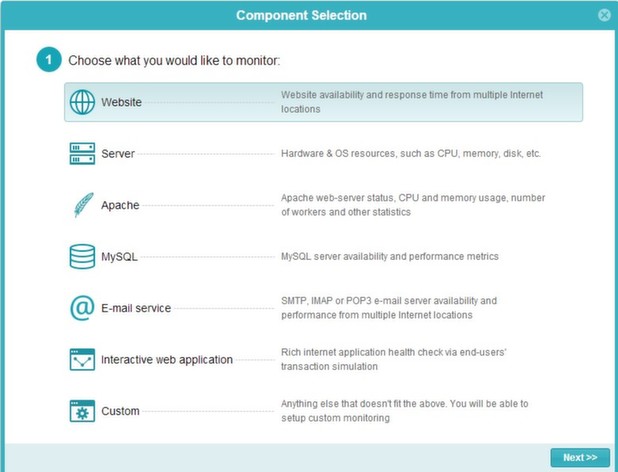
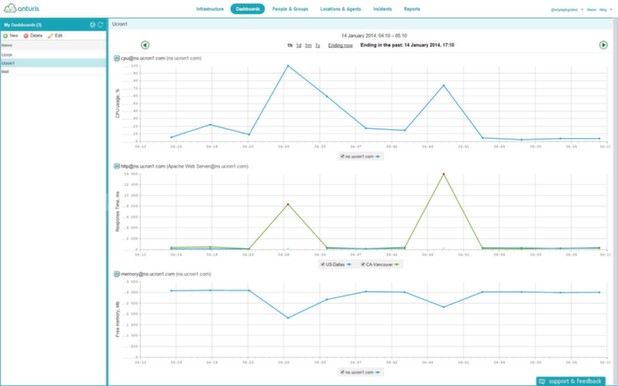
One product that does both component and end-to-end monitoring is Anturis.
The product works for in-house data centers or those operating in the cloud.
This may be a typical website or a more complex cloud service.
It may also be an email service, FTP server or VoIP.
Depending on its nature such server speaks different protocols: HTTP, IMAP, FTP, etc.
End-to-end monitoring ensures the system is working from a user perspective.
As such the monitoring tool emulates typical user scenarios and tracks how well it worked out.
to get to emulate the last two scenarios the multi-step transaction tool is required.
Multi-step transaction is essentially a process of browsing and interacting with a website by a robot that simulates visitors.
This way a better verification of interactive web applications is performed.
An agent is needed to monitor the OS, server resources, and local app metrics.
To define what is normal behavior, it is necessary to enter thresholds into the utility.
When the response time exceeds the threshold, the dashboard marks the items as red.
Dr. Deming would have us set such a threshold by calculating the t-test statistic.
(People today would call such an approach Analytics.)
The aim is to calculate that statistic and then use it to set the threshold.
This is better than setting thresholds based upon an educated guess (i.e.
The educated guess leads one to chase down events that are statistically insignificant.
Monitoring is also important for program tuning.
Monitoring database and LDAP cache utilization can help tune their configuration.
This is what W. Edwards Deming would have wanted us to do.
