Bilinear, Trilinear, Anisotropic Filtering & More: What Does It Mean?
So let’s get dive in and see how this all works!
You’re playing the latest games at beautiful 4K ultra res.
Did you ever stop to wonder just how those graphics got there?
These are then used to make primitives, which in turn are squashed into a 2D grid of pixels.
Since we’re not going to use textures, we need to color in those pixels.
The colors jump from one level to another, there is no smooth transition.
One solution to this problem could be to use something calledGouraud shading.
It’s relatively simple to do and that’s its main benefit, as simple means speed.
This means that highlights resulting from the light could be missed entirely.
This determines how much of the pixel’s color will influence the final appearance.
This number indicates howtransparentthe pixel is.
Why the history lesson?
Together, they simulate the visual effects seen in movies or how light interacts with different materials and surfaces.
For now, we’ll also drop thezcoordinate from the vertices and keep everything on a flat plane.
From left-to-right, we have the texture’su,vcoordinates mapped directly to the corner vertices’x,ycoordinates.
This is one way of doing something that’s seen in lots of 3D games: texture repeating.
Common examples of this can be found in scenes with rocky or grassy landscapes, or brick walls.
Now let’s try it again, but this time zoomed right into one of the crates.
This texture has gone through something calledtexture magnification.
However, texture minification and magnification present fresh problems that have to be resolved somehow.
Enter the mini-me of textures
The first issue to be fixed is for textures in the distance.
A common solution to the use of big textures being squashed into tiny primitives involves the use ofmipmaps.
Each level of mipmap texture has half the linear dimensions of the previous one.
The thing is, though, who wants blurry textures spoiling the background of their favorite game?
In other words, texture sampling would be nothing more than a straight 1-to-1 texel-to-pixel mapping process.
That’s a bit of a problem.
And yes, that’s a problem too.
copied from memory) and then blended with the pixel’s original color.
Here comes linear filtering to the rescue.
These 4 texels are then blended together using a weighted formula.
And Direct3D’s name for this?Trilinearfiltering.
Your guess is as good as ours…
The setting controls the maximum number of additional texel samples that are taken per original linear sampling.
For example, let’s say the game is set to use 8x anisotropic bilinear filtering.
This means that instead of just fetching 4 texels values, it will fetch 32 values.
So smooth, it’s almost delicious!
So, for 128 texel samples blended into one, that requires at least 16 clock cycles.
Okay, so perhaps performance isn’t that much of an issue!
Let’s have a look at why this change came about.
Twenty years ago, games performed single pass rendering pretty much all of the time.
For a long time it was, and game programmers did everything they could to reduce this workload.
And most of these tricks involved using textures calledheight mapsandnormal maps.
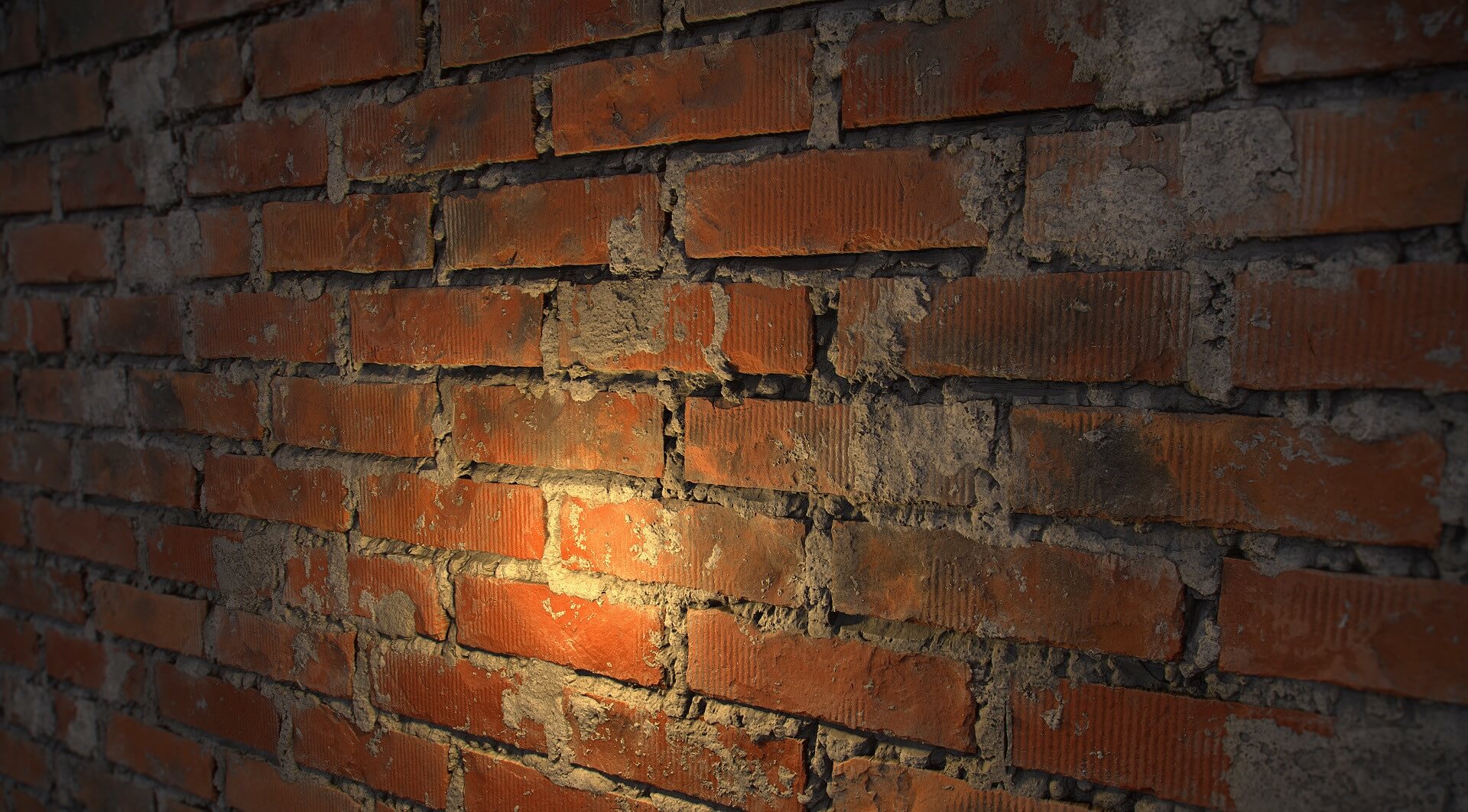
For example, in the above image, there is a realistic brick texture applied to 2 flat surfaces.
The result is that the bricks themselves look more 3D, even though they are still totally flat.
But for a quick trick of adding more detail to a surface, bump mapping is very popular.
A normal map is like a height map, except the colors of that texture are the normals themselves.
In other words, a calculation to convert the height map into normals isn’t required.
You might wonder just how can colors be used to represent an arrow pointing in space?
Modern games now use a stack of textures to improve the quality of the magic trick being performed.
Instead, just 5 textures and a lot of clever math gets the job done.
a smoothed brick reflects more consistently that rough mortar does).
Texture mapping is crucial
Texturing is absolutely crucial to game design.
The designers were keen on creating as realistic a world as possible, for the given period.
the chicken wings).
All of this happens in so many games now, because players expect greater levels of detail and realism.
The best technology never dies, no matter how old it is!
