It was unlike anything I had ever seen before.
Clearly, it was a gaming system I could tell from the dozens of screenshots adorning the box.
However, it wasn’t the Atari 2600.
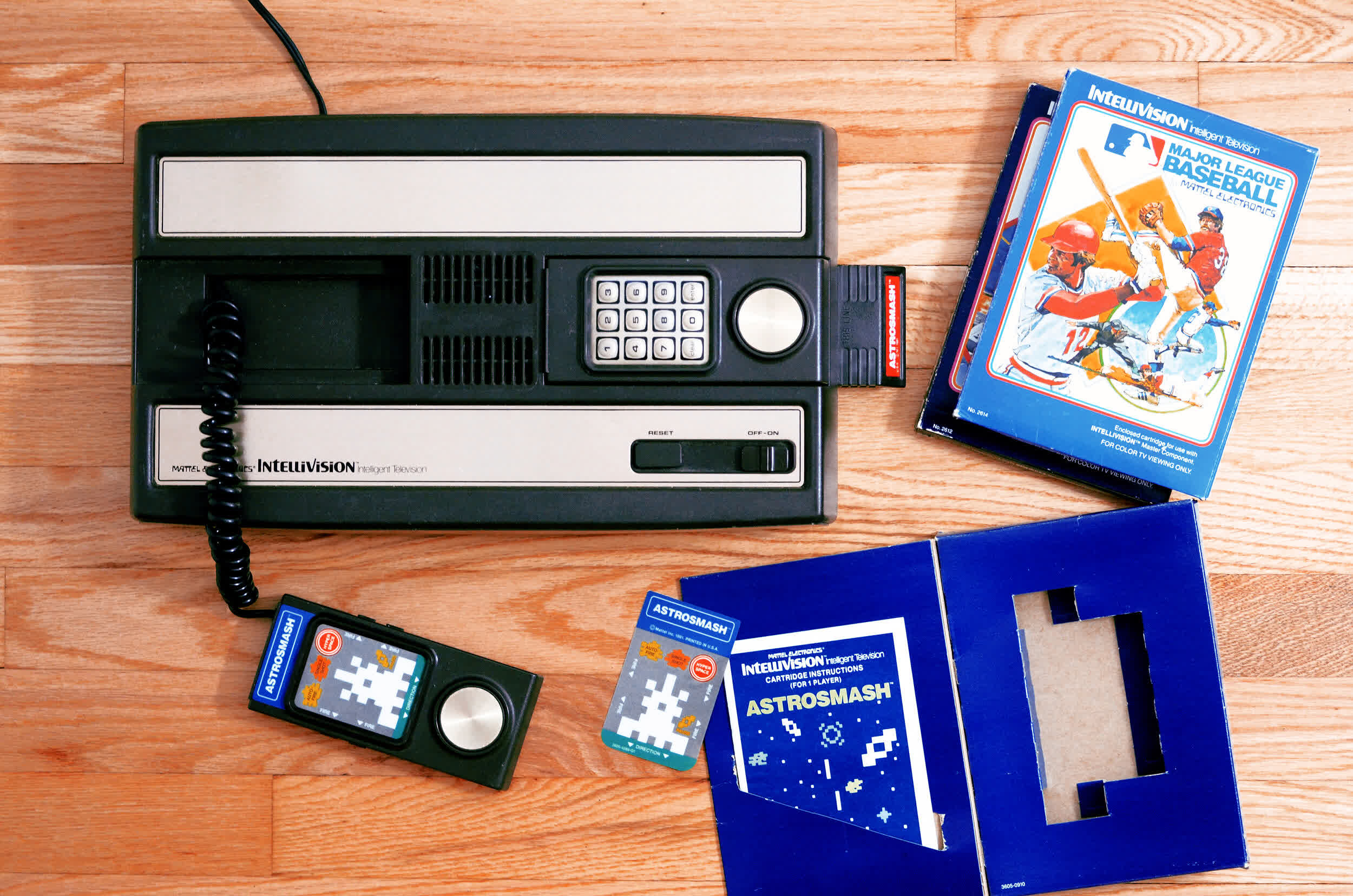
“Great,” I thought sarcastically.
I was determined to try this system out.
The disk pad controller required some adjustment, but the gameplay completely won me over.
To this day, I still argue with my cousins that my Intellivision was better than their Atari.
The mission: To beat Atari
The mission was clear: to outshine Atari.
Atari had already revived an industry flooded with first-gen Pong knockoffs by releasing the Atari 2600 in 1977.
The two-year headstart gave Atari a distinct advantage as it snatched up a large slice of the market.
That’s not to say that the Intellivision lacked great original and licensed games.
But the console also featured some highly addictive games that kept me playing well past my bedtime.
One of my favorites was Advanced Dungeons & Dragons.
As a huge fan of tabletop D&D, the Intellivision video game quickly topped my list.
Mattel licensed it from TSR, but the game was essentially an original concept.
In fact, it was the first ever D&D video game.
Astrosmash was another standout original IP.
It combined elements of Space Invaders and Asteroids.
Despite the chunky graphics, they were still superior to anything available on Atari.
It was the first game I ever mastered and could play indefinitely.
The best of the bunch was B-17 Bomber.
It was a straightforward game focused on dropping bombs from the bomb bay.
To this day, I can’t help but laugh when I think of that voice.
Not so much…
What set Intellivision apart from Atari was its processor.
The following year, sales reached 200,000 units.
In 1981, Mattel increased production and sold over one million consoles.
The only thing working against the Intellivision, aside from its cost, were the controllers.
Most players were familiar with the use of joysticks and one or two buttons, mirroring the arcade experience.
Atari stuck with tradition whendesigning the CX-40, a straightforward single-button joystick.
The Intellivision featured two wired controllers that docked on the console’s top.
These would often get bent and become annoying to insert.
The keyboard component and other bad ideas
What’s in a name?
Mattel’s gaming system was commonly referred to as simply “the Intellivision.”
However, as the company licensed the console out, it fell under other monikers.
Ironically, this vision turned out to be part of Mattel’s failure in the gaming sector.
The company intended to release a keyboard component shortly after the Master Component launch.
Mattelannouncedthe two products during CES 1979 in Las Vegas.
The “Keyboard Component,” as it was officially called, was massive.
Mattel designed it so that the Master Component would attach within it.
It was so big that its internal codename was the “Blue Whale.”
However, it was plagued with delays.
By late 1980, Mattel finally had an almost completed product toreleaseinto a test market in Fresno, California.
However, the price point was not wholly unreasonable, considering the gadget was not just a peripheral.
The two processors could act independently, creating something like a composite graphical output.
In fact, many families bought the Master Component intending to pick up the keyboard on release.
When Mattel failed to deliver the machine when advertised, customers complained.
The FTC became involved and opened an investigation into Mattel for false advertising and fraud.
Mattel then canceled the machine.
As part of the FTC settlement, Mattel bought back all units it had sold to test markets.
They were also given vouchers worth $1,000 in Mattel Electronics products.
However, the FTC still wanted to see a released gadget before easing up on the fines.
Fortunately, Mattel had an ace in the hole.
The struggles of the Keyboard Component created a rift in Mattel’s upper management.
So they set up a separate secret division tasked with creating a cheaper and more profitable machine.
It was an introductory computer programming system for kids called the “Basic Development System.”
It lowered the RAM from 16KB to 2KB and ditched the secondary processor and the high-resolution text.
It also went with a much simpler cassette and printer interface.
It began marketing efforts during the 1982 holiday season and showed off the system at CES 1983.
Unfortunately, management had become disenchanted with offering hardware add-ons and decided to focus solely on software.
Before giving up, Mattel had had many other irons in the fire where hardware was concerned.
For example, it successfully launched a follow-up to the Master Component called “Intellivision II.”
It was the same as the original, except for its reduced size and lower manufacturing cost.
The video game crash of 1983 ultimately led to the shutdown of the Intellivision division.
In 1984, Mattel sold the rights and assets to a group of former Mattel executives and investors.
This group formed the INTV Corporation, which continued to support and expand the Intellivision brand until 1990.
That year, the INTV Corporation declared bankruptcy, and the Intellivision brand was officially discontinued.
The company ported the games to MSDOS and released Intellivision for PC Volume 1.
It was a free download that included three games and an emulator.
They followed up with volumes 2 and 3 and expanded the emulation to Windows and Macintosh.
The following year the company launchedIntellivision Lives!, followed by Intellivision Rocks in 2001.
These compilations included over 100 emulated games on CD for DOS, Windows, and Mac.
Consoles also saw various Intellivision compilations.
In a licensing deal with Intellivision Productions, Activision released Intellivision Classics for the PlayStation in 1999.
Likewise, Crave Entertainment ported Intellivision Lives!
to the PlayStation 2, Xbox, and GameCube.
Other publishers brought versions of Intellivision Lives!
to the Nintendo DS and the Xbox 360.
The surge in retro gaming also saw a miniature console hit the market in 2014.
In 2018, veteran video game music composerTommy Tallaricoannounced he had acquired the Intellivision brand and formed Intellivision Entertainment.
Later that year, he unveiled the Intellivision Amico, a next-gen version of the beloved console.
The Amico was not meant to compete with the likes of the PlayStation 5 or Xbox Series.
For a time, things appeared to be going very well.
A slick reimagined design in a smaller form factor with arguably unnecessary but cool LED lighting looked nice.
The games announced for the Amico, while retro in style, were modern in substance.
The projectraised over $11 million.
But that didn’t happen.
Nor did subsequent rescheduled release dates.
Ultimately, the Intellivision Amico project encountered insurmountable challenges.
In November 2023, Intellivision acknowledged insufficient funds to finance the console’s production.
We cover the most prominent part of their history, innovations, successes and controversies.
