Saturday’s flybyprovidedNASA with many raw images, which it released to citizen scientists for post-processing.
Its largest is Loki Patera, about twice the size of Hawaii’s Mauna Loa.
NASA calls Io a “tortured moon” because of this tumultuous activity.
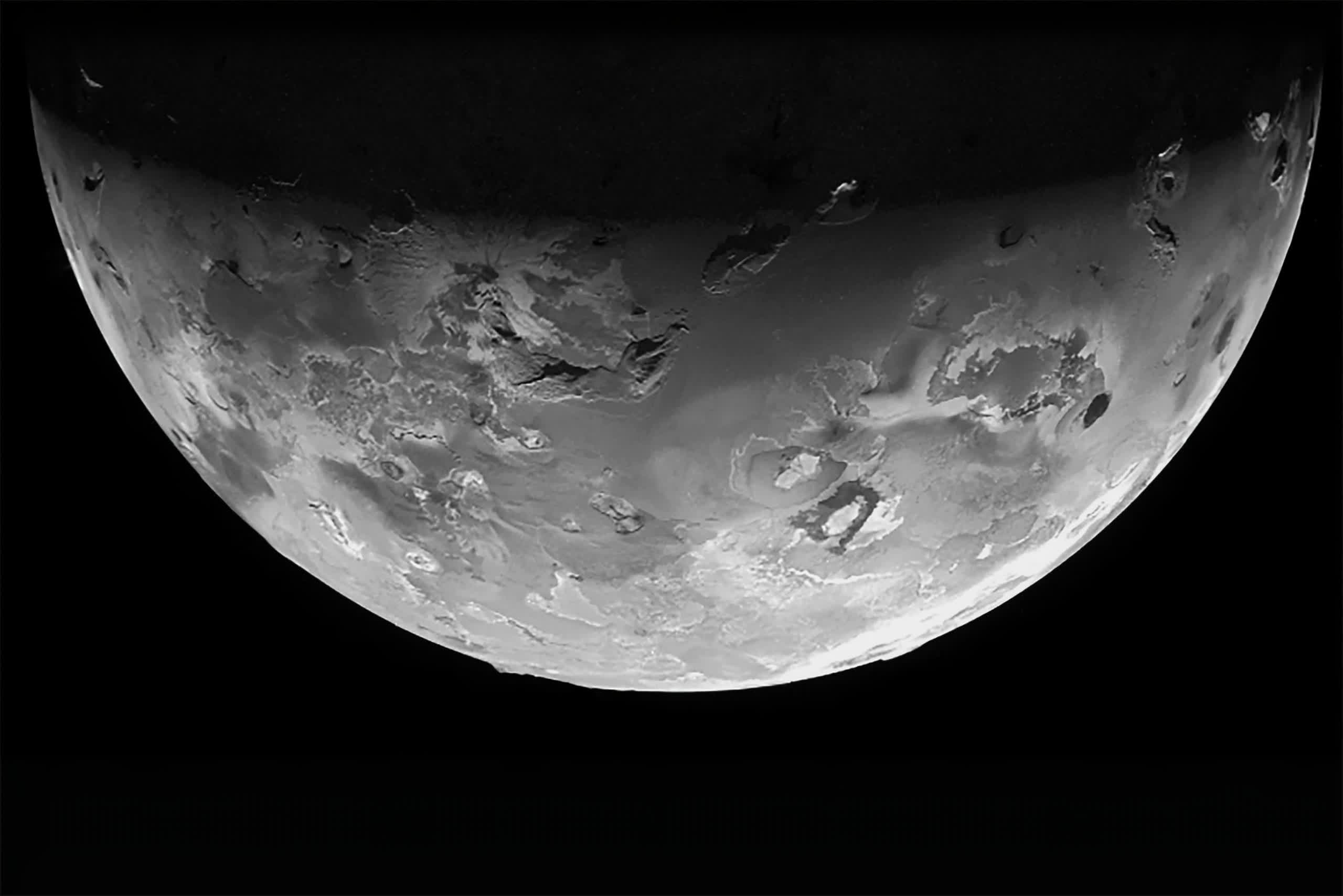
However, lava quickly fills impacts, leaving no trace.
The dark spots (below) are the remnants of collapsed volcanoes.
Massive lava flows will eventually bury these, too.
Scientists want to learn more about what makes Io so violent.
The Jovian probe’s latest flybys could provide some clues.
In addition to imagery, Juno collected reams of data to analyze.
Since Io appears to have a magnetic field, scientists think it has a solid iron core.
Its surface seems to be just a thin, constantly changing crust floating on molten rock.
This hypothesis explains the constant eruptions and huge fiery lakes of lava that cover the surface.
The tidal pull from these large masses creates constant friction on Io, lending to its volcanic activity.
NASA is unsure of the contents of Io’s mantle.
One line of reasoning is that it’s primarily molten sulfur.
This supposition would explain the moon’s yellowish tint and sulfur dioxide atmosphere.
Perhaps Juno’s latest runs can provide the answers.
