Load Time Battle
Article Index
Today we’re revisitingstorage performancewith an emphasis on gaming.
We’ll be able to look back on this tests to see how things have changed.
Do you need a PCIe drive?
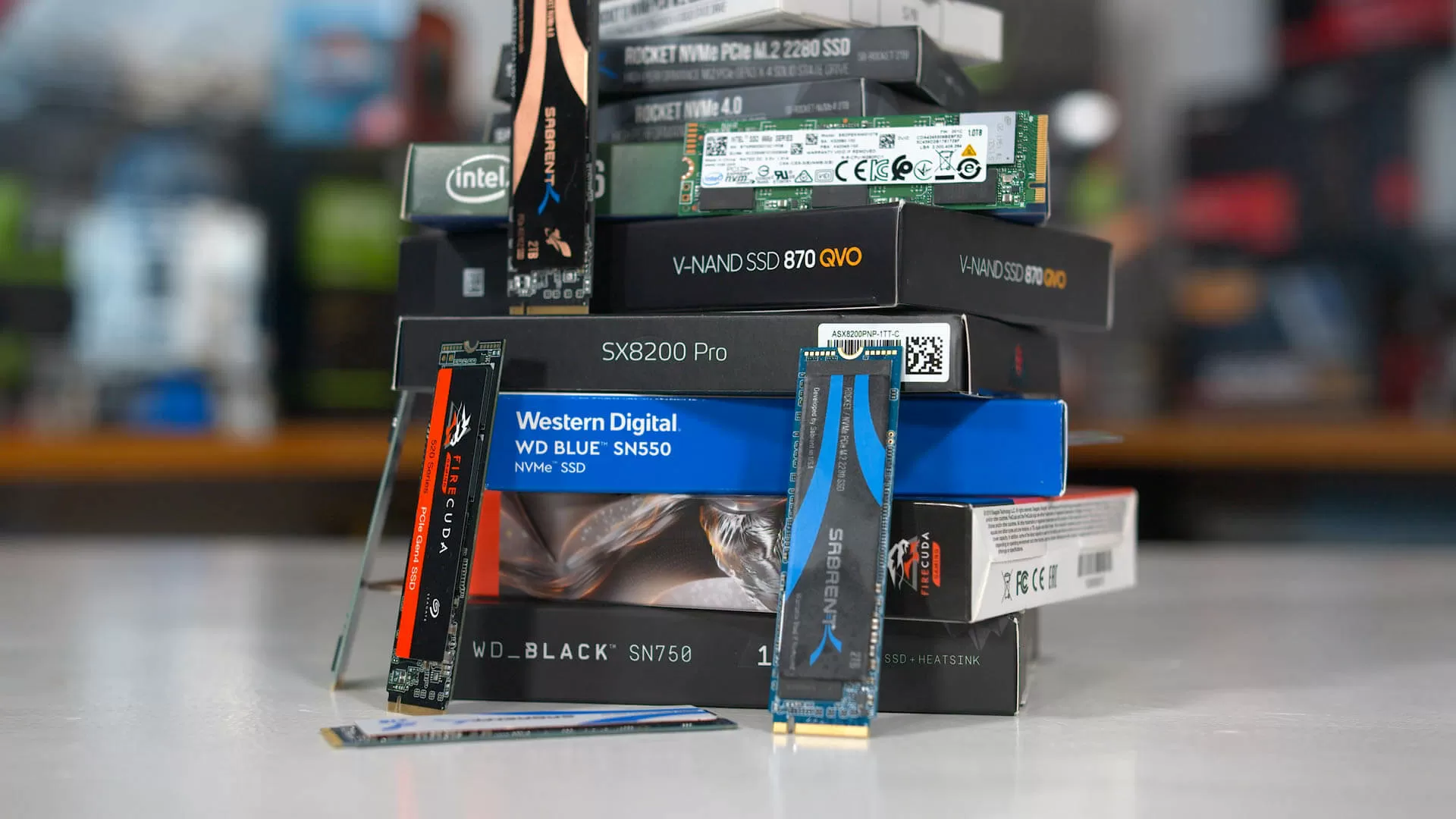
Do you need something with a DRAM cache?
Are certain memory technologies worse than others?
Representing Team Hard Drive in today’s battle is the Western Digital WD120EMAZ 12TB.
We’re fully expecting this guy to be slow.
Team SATA SSD has three contenders.
We have lots of PCIe 3.0 x4 SSDs for today’s testing as well.
From Western Digital we have both the WD Black SN750 and WD Blue SN550 in 1TB capacities.
Both use SanDisk TLC, but the SN750 has a DRAM cache where the SN550 does not.
You’ll also spot this pre-installed heatsink on the SN750.
So this is an alternative to the SN750 with different components.
Then rounding out our PCIe 3.0 offerings are two QLC drives.
Both drives also feature DRAM caches.
Then we have three PCIe 4.0 drives, all of which use essentially the same design.
The Sabrent Rocket 4.0 2TB is similar, but with a larger capacity.
And last but not least, we have an SSD with a USB interface, the Samsung T5.
There’s also a DRAM cache here, as is the case for the PCIe 4.0 drives.
For sequential reads, it’s a pretty simple story.
At the top with 5 GB/s transfer speeds, are the PCIe 4.0 drives.
SATA SSDs also suffer, offering just a quarter of PCIe 3.0 performance in the best cases.
So that’s a quick look at the synthetic numbers.
But does this matter for game loading?
Let’s find out.
But beyond that, there’s just a 36% improvement moving from the slowest to fastest SSD tested.
There is a small gap between the SATA/USB and PCIe 3.0 drives.
On average the non-PCIe SSDs loaded in 21 seconds, compared to 17 seconds for the PCIe equipped models.
That doesn’t materialize when loading games.
The difference is even less pronounced in Death Stranding.
There was a mere 2 second difference in load times between the fastest and slowest SSD models.
Even the hard drive does reasonably well in this game, loading in 22 seconds.
However, it’s clearly better to have at least some form for SSD for loading Tomb Raider.
This is another game where we didn’t see a big speedup coming from a hard drive to SSD.
The Outer Worlds was a game we chose to test because it has a lot of loading screens.
However, it only appears to require an SSD to be fast, not any specific sort of SSD.
And there was no preference for PCIe over SATA, it was a bit of everything.
Next we have loading into The Division 2.
The differences aren’t huge though.
The final game we wanted to check out is Planet Coaster.
However what’s really important to realize is these load times are not due to slow storage speeds.
There’s also little difference between different SSD specifications.
QLC memory is not slower than TLC for reading game files.
Having a DRAM cache is also not important for game loading.
What We Learned
Why don’t games benefit all that much from faster SSDs?
Well, it seems clear that raw storage performance is not the main bottleneck for loading today’s games.
You’re better off buying an affordable SSD drive with a high capacity.
That makes the SATA model better value for gamers, but not by much.
At this capacity, it may make more sense to stick with SATA.
The Sabrent Rocket is a popular choice as well.
These drives are around $25 more at 1TB than their DRAM-less or QLC based entry-level competitors.
As a boot drive, it’s well worth spending that extra cash.
